
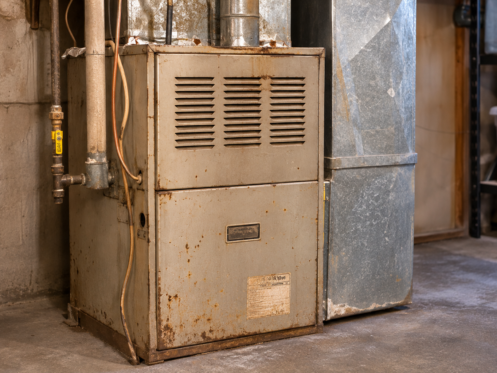
Is it worth replacing a 30 year old furnace?
Yes, replacing a 30-year-old furnace is usually a worthwhile investment. Most gas furnaces have an expected service life of approximately 15 to 20 years, meaning a 30-year-old system is well beyond its typical lifespan. Replacement can improve heating efficiency and reliability while addressing concerns associated with aging components and potential safety problems.
Why a 30-Year-Old Furnace Is Usually Ready for Replacement
A furnace that has operated for three decades has provided many years of heating, but continued operation does not necessarily mean the equipment remains reliable or efficient.
Furnaces contain mechanical, electrical, and combustion-related components that experience wear during normal use.
Over time, these components can deteriorate, become less dependable, or require increasingly frequent repairs.
A 30-year-old furnace may still produce warm air, but homeowners should evaluate its overall condition rather than relying exclusively on whether it turns on.
Important considerations include:
- The furnace’s maintenance and repair history.
- Whether heating performance has become inconsistent.
- The condition of major mechanical components.
- The equipment’s original energy efficiency rating.
- The availability of appropriate replacement parts.
- The results of a professional safety inspection.
Age alone does not prove that a furnace is unsafe. However, equipment that has operated significantly beyond its expected service life deserves careful evaluation.
How Much More Efficient Is a Modern Furnace?
Gas furnace efficiency is commonly expressed using Annual Fuel Utilization Efficiency, or AFUE.
Older, low-efficiency furnaces may have AFUE ratings between approximately 56% and 70%.
By comparison, modern high-efficiency gas furnaces can achieve ratings of 90% or higher.
However, homeowners should distinguish equipment efficiency from guaranteed utility savings.
Actual heating expenses depend on factors such as:
- Natural gas prices.
- Thermostat settings.
- Home insulation and air leakage.
- Furnace sizing and installation.
- Household heating preferences.
- Seasonal weather conditions.
What Safety Concerns Come With an Aging Furnace?
Safety is another important consideration when evaluating a 30-year-old gas furnace.
One component that deserves particular attention is the heat exchanger.
The heat exchanger transfers heat from the combustion process to the air circulated throughout the home while keeping combustion gases separated from indoor air.
Over time, deterioration or damage can compromise this component.
Other safety-related concerns can involve venting, combustion performance, and deteriorating equipment components.
Working carbon monoxide alarms provide an additional layer of protection, but they do not replace professional furnace maintenance.
Furnace Replacement Considerations for Denver Colorado Homes
Denver, Colorado experiences cold winter conditions that place substantial demands on residential heating systems.
An aging furnace may operate through mild weather but struggle during extended periods of colder temperatures.
This makes heating reliability particularly important when evaluating replacement.
Homes in Denver, Colorado also have different heating requirements depending on their size, insulation, windows, and construction.
An appropriately performed heating load calculation helps determine the capacity needed for the home.
Ductwork condition and airflow should also be considered.
Premier Heating and Air offers replacement consultations that include heat load calculations to help homeowners evaluate suitable equipment.
Common Myth: If an Old Furnace Still Works, Replacing It Is Unnecessary
A furnace does not have to stop working completely before replacement becomes reasonable.
Older equipment can continue producing heat while operating inefficiently or developing mechanical problems.
Waiting for complete failure may also limit the opportunity to compare replacement options carefully.
However, replacement should not be based on age alone without considering the furnace’s condition.
The most informed decision considers safety, efficiency, repair history, reliability, and long-term heating needs.
FAQ
Is it worth replacing a 30 year old furnace?
Yes, replacing a 30-year-old furnace is usually worth considering. Most furnaces have an expected service life of approximately 15 to 20 years, and older equipment may operate less efficiently and require more repairs. Denver homeowners should have aging furnaces inspected for safety and compare replacement options based on efficiency, condition, and heating requirements.
Can a furnace last 30 years?
Yes, some furnaces operate for 30 years, but this exceeds the typical expected service life. Continued operation does not necessarily indicate that the equipment remains efficient or dependable.
Is a 30-year-old furnace dangerous?
Not automatically. However, aging components and potential heat exchanger deterioration make professional safety inspection particularly important.
Will replacing an old furnace lower heating bills?
A higher-efficiency replacement may reduce fuel consumption, but actual savings depend on heating demand, energy prices, equipment selection, and installation quality.
Should I repair or replace a 30-year-old furnace?
Replacement is often worth considering, particularly when repairs are expensive or frequent. A professional evaluation can help compare immediate repair needs with replacement costs.
Conclusion
Replacing a 30-year-old furnace is usually worth considering because of the equipment’s age, potential efficiency improvements, and concerns about reliability and safety. A professional inspection and heating load calculation can help homeowners determine the most appropriate replacement approach.

